
What is the Saltwood House?
The Saltwood House is a fictional family home on a bushy, sloping block on Sydney’s Northern Beaches. We use it to show how Emily compares systems for one roof. The pricing and savings come from an Emily estimate for a comparable large home; the house, family and photos are illustrative.
It is built as three sandstone and timber pavilions, each under a single sloping roof tilted to the north. Those three roofs, plus a detached garage, give Emily room for up to 45 panels.


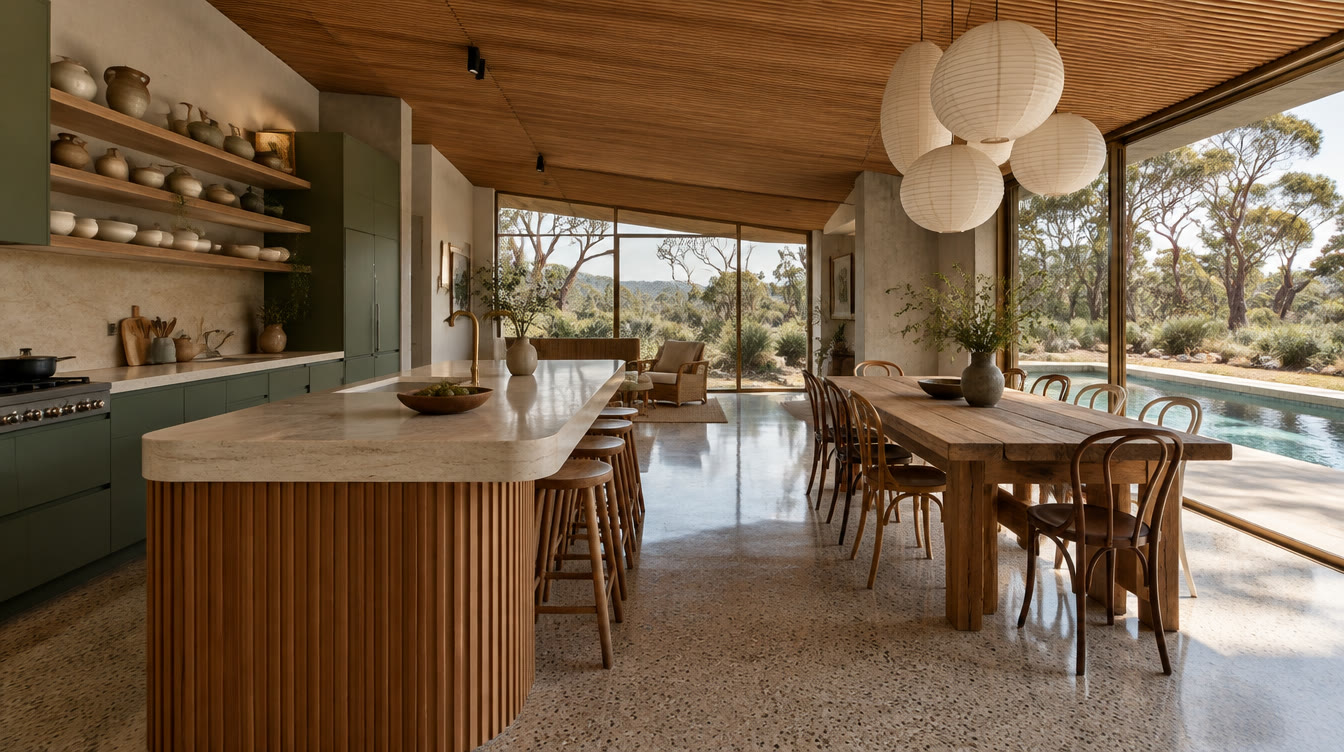
| Feature | The Saltwood House |
|---|---|
| Bedrooms | 5 plus a study |
| Bathrooms | 3 |
| Pool | 25 m lap pool |
| Usable roof faces | 4 (three pavilions and the garage) |
| Location | Northern Beaches, Sydney NSW |
Where does a house like this use power?
A big home uses a lot of power after sunset, when grid power costs the most. A battery pays its way by moving midday solar into the evening.
Pool pump
Runs daily. Schedule it for midday and it runs on sunshine.
Air-con
Five bedrooms and a study cooled through a Sydney summer, mostly in the evening.
EV charging
Overnight top-ups in the garage come straight from the battery.
Family of five
Laundry, kitchen and three bathrooms running morning and night.
What three systems did Emily price?
Emily mapped the roof in 3D and returned three options. Every price includes the government rebate.
Rebate Maximiser
- Net investment
- $24,300–$31,894
- Rebate included
- $11,966
- Payback
- 5.4–7.1 yrs
- Saving per year
- $3,886–$4,295
- 10-year NPV
- $2.9k
High Performer
- Net investment
- $22,061–$28,955
- Rebate included
- $10,229
- Payback
- 5.7–7.4 yrs
- Saving per year
- $3,312–$3,661
- 10-year NPV
- $0.9k
Smart Starter
- Net investment
- $5,196–$6,819
- Rebate included
- $4,246
- Payback
- 1.9–2.4 yrs
- Saving per year
- $2,506–$2,769
- 10-year NPV
- $13.9k
Why compare on NPV instead of payback or IRR?
Payback only tells you how fast the money comes back, and a high return (IRR) on a small system can hide how little it earns in dollars. Net present value (NPV) is what the system is worth to you today once future savings are discounted back, so a dollar saved in year 12 counts for less than a dollar saved next year.
Model: midpoint of each price and saving range, net investment paid in year 0, savings falling 0.5% a year as panels age, discounted at 5% a year. At a 7% discount rate the order is the same.
Which system is the best investment?
On the numbers, the smallest system wins. Smart Starter has the highest NPV at 10, 15 and 20 years. Rebate Maximiser saves about $1,450 more each year, but costs about $22,000 more up front. Over 15 years that extra spend only earns back roughly what it costs.
High Performer costs about $2,600 less than Rebate Maximiser but saves about $600 less each year. On this roof, most families would choose one of the other two.
So why would anyone choose the 50 kWh Rebate Maximiser?
The NPV prices this house as it is today. Families who choose the bigger system are paying for what the house will need next, and for peace of mind.
The lights stay on
A 9.6 kWh battery covers the fridge, lights and wifi for an evening. 50 kWh runs the whole house, air-con and pool pump included, through a day-long outage.
The house will use more power
A second EV, a heat-pump hot water system and switching off gas can roughly double usage. Smart Starter’s savings stop growing; Rebate Maximiser has room.
Adding more later costs more
Expanding later means a second installation and call-out fee, and the federal battery rebate is set to step down over time.
Earnings the estimate leaves out
A big battery can join a virtual power plant (VPP) and get paid at peak times. Home EV charging also replaces petrol. Neither is in the saving above.
Protection against price rises
If electricity prices climb, the saving rises with them. The bigger system protects more of the bill.

What does it really cost to own over 15 years?
A quote shows the install price. Over 15 years three more costs come in: batteries slowly hold less charge, the system needs the odd check-up, and the inverter usually needs replacing once.
| System | Headline 15-yr NPV | Battery wear | Check-ups | New inverter | Real 15-yr NPV |
|---|---|---|---|---|---|
| Rebate Maximiser | $13,092 | −$2,389 | −$823 | −$2,227 | $7,653 |
| High Performer | $9,599 | −$2,036 | −$823 | −$2,227 | $4,513 |
| Smart Starter | $20,551 | −$1,540 | −$823 | −$1,392 | $16,795 |
What costs might not be in a solar quote?
Not every home needs these, so they are left out of the numbers above. Ask your installer to confirm each one in writing before you sign.
Switchboard upgrade
$1,000–$3,000Older switchboards often can’t safely take a solar and battery system.
Two-storey or steep roof
VariesScaffolding and roof safety gear add to the install. Tile roofs can cost more than metal.
Re-roofing later
VariesPanels have to come off and go back on if the roof is repaired or replaced.
Inverter warranty extension
$150–$600Optional; some brands only allow it if you register within 12 months.
Mismatched equipment
Warranty riskSome batteries must pair with a specific inverter brand, or both warranties can be void.
Export limits
Lower earningsYour network may cap how much you can send to the grid, and feed-in rates keep falling.

See your three options, priced for your roof
Emily measures your actual roof and shows each system’s price, saving and payback as ranges. About a minute, no sign-up.
Frequently asked questions
Which solar system pays back fastest for a large home?
For the Saltwood House, the 6.6 kW Smart Starter with a 9.6 kWh battery pays back in 1.9 to 2.4 years, because it costs about $6,000 after a $4,246 rebate and saves about $2,600 a year.
Is a bigger solar and battery system always a better investment?
No. In this case study the 19.8 kW, 50 kWh system saves about $1,450 more a year than the smallest option but costs about $22,000 more, so its 15-year NPV is lower. A bigger system makes sense when your power use will grow, or when backup and energy security matter to you.
What is NPV and why does it matter for solar?
Net present value is what a system’s future savings are worth today, minus what you pay. It lets you compare systems of different sizes in dollars, which payback period and IRR alone cannot.
How long do solar panels, inverters and batteries last?
Panels usually last 25 to 30 years or more, with performance warranties of 25 to 30 years. String and hybrid inverters typically last 10 to 15 years and cost about $1,500 to $4,500 to replace. Batteries usually carry a 10-year warranty that guarantees 60% to 70% of the original capacity.
Do solar panels need yearly maintenance?
There is no compulsory yearly fee. Rain does most of the cleaning. Installers usually suggest a safety and performance check every few years, roughly $150 to $300 a visit.
Keep reading
Sources
- System pricing, rebates, payback and yearly savings: an Emily estimate (EnergyBrain, built on GreenSketch rooftop analysis), October 2026
- NPV and ownership-cost figures: EnergyBrain calculation from those estimates, using the assumptions stated on this page
- Why Solar: Solar warranty comparison chart, Australia 2026
- SolaX: How long do solar inverters last in Australia
Editorial note (October 2026): the Saltwood House, its family and its photos are fictional and the images are AI-generated renders. Prices, rebates and savings are modelled estimates, not quotes, and actual results vary by property. Ownership costs and NPV are calculated from stated assumptions. Prices, rebates and incentives must be checked again for the date and location of any installation. This is general information, not personalised financial advice.